International Development and Education MA
- Study mode and duration
- Course code
- 4081f
- Fees (per year)
- Typical entry requirements
-
View full entry requirements - Course delivery
- On Campus
Course information for entry year:
Overview
We work with NGOs, charities and schools to offer you a dedicated placement, giving you practical experience, the chance to make a real impact, and the skills employers value.
This degree prepares you for a number of future paths. You could:
- advance your career in international development
- transition into a new role within NGOs, charities, or education organisations
- progress to doctoral study
You'll graduate ready to contribute meaningfully to global development and education.
Why choose this Master’s in International Development and Education?
What sets this postgraduate degree apart is the integration of academic study with a practical placement where you carry out your own research to co-create change. You'll take a multidisciplinary approach to international development, and consider contemporary global change through various perspectives, including:
- social
- political
- historical
- environmental
- economic
Placement module: the opportunity to make an impact
Extend your learning into the field of development and education through a dedicated placement module, either in person or virtually. The placement module provides you with hands-on experience. You'll:
- carry out your own research study and apply your knowledge in real-world settings
- participate in an informed way in discussions and debates on development issues and education
- develop practical knowledge of schooling and education in the Global South or Global North
- consider problems and challenges with first-hand engagement, either in person or virtually
- translate your learning into practical impact
Learn from global experts
Learn from lecturers who are experts in the field with extensive experience working across Asia and Africa. Our lecturers advise on policy relating to global challenges and carry out world-leading research. Lecturers are engaged in interdisciplinary research on:
- children's literacy
- health
- gender
- water
- sanitation
- nutrition
Learning aligned with sustainable development
The run through the modules. This helps you understand global progress towards a better future for people and the planet by 2030. You will also explore current debates about how education contributes to the development process.
Important information
We've highlighted important information about your course. Please take note of any deadlines.
Please rest assured we make all reasonable efforts to provide you with the programmes, services and facilities described. However, it may be necessary to make changes due to significant disruption, for example in response to Covid-19.
View our Academic experience page, which gives information about your 缅北禁地 study experience for the academic year 2025-26.
See our terms and conditions and student complaints information, which gives details of circumstances that may lead to changes to programmes, modules or University services.

My course is helping me explore international development and the important role of education in changing millions of people’s lives around the world.
Quality and ranking
Professional accreditations are reviewed regularly by professional bodies to ensure they meet the latest industry practices and regulatory standards. This keeps your degree rigorous, relevant, and highly valued by employers, providing a clear pathway into your chosen career.
If you are studying an accredited degree and considering a career in Europe after graduation, it is important to stay informed about international standards. The best resource for current information is the .
This official resource provides essential details on:
- whether your profession is regulated in another country.
- the specific steps you need to take to practice abroad.
- which organisations you should contact to begin the process.
Our students

Isabel from Ecuador
International Development and Education MA
One thing I love about the University is the focus on wellbeing and work-life balance. We can find support for almost everything!


Chinomso from Nigeria
International Development and Education with Cross-cultural Communication MA
If you're passionate about saving the world through education, 缅北禁地 has the right course for you.


Yilong from China
MA Applied Linguistic and TESOL
The School of Education, Communication and Language Sciences have an excellent reputation, specifically for its TESOL programmes.


Nicky from United Kingdom
Doctor of Education
I choose 缅北禁地 for my EdD because of the quality of teaching staff in ECLS.


Lorrencia from Ghana
Cross Cultural Communication & International Relations MA
缅北禁地 has been instrumental in helping me see the vision of my life.

Beverley from United Kingdom
Doctor of Education
I was impressed by the support and opportunities offered to part time mature students.

Stuart from United Kingdom
Doctor of Education
I thoroughly enjoyed undertaking the EdD, the format and the shape of the doctorate.
What you'll learn
On this MA you’ll: 鈥�
- learn through case studies to think critically about development issues 鈥��
- collect data in development contexts. You’ll design and administer surveys using Qualtrics, addressing ethical and contextual challenges in development research
- develop skills in analysing quantitative data using statistical software packages SPSS and Stata
- learn to source, evaluate, and analyse secondary data from existing datasets. You'll investigate development trends and inform evidence based policy and research insights
You'll be taught through a range of compulsory modules.
They discuss the balance between academic learning and practical application on the placement module.
Modules
The module information on our course pages is intended to provide an example of what you will study.
Our teaching is informed by research. Course content changes periodically to reflect developments in the discipline, the requirements of external bodies and partners, and student feedback.
Full details of the modules on offer will be published through the Programme Regulations and Specifications ahead of each academic year. This usually happens in May.
Some courses have optional modules. Student demand for optional modules may affect availability.
| Compulsory Modules | Credits |
|---|---|
| Research Strategies and Methods | 20 |
| The Future of Learning in the Digital Age | 20 |
How you'll learn
Depending on your modules, you'll be assessed through a combination of:
- Design or creative project
- Dissertation
- Essay
- Professional skills assessments
- Oral presentation
- Portfolio
- Research proposal
- Written examination
Throughout your studies, you’ll have access to support from:
- academic staff
- academic advisers and research supervisors
- our University Student Services Team
- student representatives
- peers
You'll also be assigned an academic member of staff, who will be your academic adviser throughout your time with us. They can help with academic and personal issues.
Your teaching and learning is also supported by Canvas. Canvas is a Virtual Learning Environment. You'll use Canvas to submit your assignments and access your:
- module handbooks
- course materials
- groups
- course announcements and notifications
- written feedback
You'll get the opportunity to study with our world-class academics, including:
Your development
Placements
The two to four-week placement module offers an exciting opportunity to visit a country in the Global South (Africa, Asia and Latin America).
We're currently working with local charities and NGO's, and , to offer exciting placements in Tanzania and Kenya. We also offer placements in schools with our contacts at in India. The self-funded visit provides an invaluable experience that will bring issues learnt on the course to life.
The placement module can also be taken in the UK, across, Europe, as a virtual placement, or in your country of origin, with the agreement of the Degree Programme Director.
Entry requirements
The entrance requirements below apply to 2027 entry.
Qualifications from outside the UK
English Language requirements
Admissions policy
This policy applies to all undergraduate and postgraduate admissions at 缅北禁地. It is intended to provide information about our admissions policies and procedures to applicants and potential applicants, to their advisors and family members, and to staff of the University.
University Admissions Policy and related policies and procedures
Credit transfer and Recognition of Prior Learning
Recognition of Prior Learning (RPL) can allow you to convert existing relevant university-level knowledge, skills and experience into credits towards a qualification. Find out more about the RPL policy which may apply to this course
Your future
What can you do with a Master's in International Development and Education?
Our graduates go on to pursue careers in:
- education in developing countries
- the global education industry
- national governments
- international aid agencies
- non-governmental organisations and charities
Stefani graduated from the MA in International Development and Education in 2022. She shares how her time on campus shaped her career prospects.
Our Careers Service
Our expert Careers Service is here to help you take the next steps in your professional life. We will support you while you’re studying with us and for up to three years after you graduate.
You will have access to expert one-to-one advice and guidance through our campus careers centre and online, along with digital resources, workshops, networking opportunities, and careers and recruitment events.
We’ve been awarded 5 QS Stars for Student Employability (2025). Many of our degrees are shaped by strong links with national and international businesses. We are committed to helping you access real-world experience opportunities and develop key skills through paid work placements and internships.
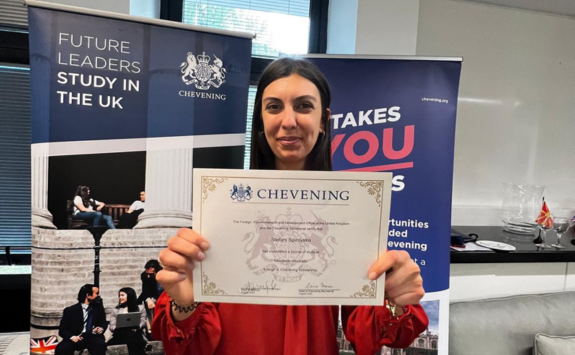
I now work as a Programme Manager for the Westminster Foundation for Democracy in the office in Skopje, North Macedonia. My work is focused on strengthening the institutional capacities in North Macedonia and connecting them to the needs of our citizens, in particular our country’s youth.
Facilities
As a student in the School of Education, Communication and Language Sciences you'll have access to facilities and a growing collection of online resources, including:
- a well-stocked Education Resource Centre
- Language Analysis Lab
- a phonetics lab
- an audio-video lab
- a recording studio
You will have access to a range of IT systems and software, and library resources including electronic journals and databases.
缅北禁地 Library is an award-winning service consisting of four buildings on campus and one off-campus facility, home to over 0.8 million print books, over 0.7 million e-books and over 54,000 e-journal titles.
The library also has study spaces, a postgraduate study rooms, computer clusters, media room and café.
Fees, Funding and Scholarships
Tuition fees for 2027 entry (per year)
As a general principle, you should expect the tuition fee to increase in each subsequent academic year of your course, subject to government regulations on fee increases and in line with inflation.
Depending on your residency history, if you’re a student from the EU, other EEA or a Swiss national, with settled or pre-settled status under the EU Settlement Scheme, you’ll normally pay the ‘Home’ tuition fee rate and may be eligible for Student Finance England support.
EU students without settled or pre-settled status will normally be charged fees at the ‘International’ rate and will not be eligible for Student Finance England support. You may be eligible for a scholarship worth 25% off the international fee. Search our funding database.
Scholarships
We support our EU and international students by providing a generous range of Vice-Chancellor's automatic and merit-based scholarships. See our searchable postgraduate funding page for more information.
Search for funding and scholarships
Find funding available for your course
What you're paying for
Tuition fees include the costs of:
- matriculation
- registration
- tuition (or supervision)
- library access
- examination
- re-examination
- graduation
Find out more about:
If you are an international student or a student from the EU, EEA or Switzerland and you need a visa to study in the UK, you may have to pay a deposit.
You can check this in the How to apply section.
If you're applying for funding, always check the funding application deadline. This deadline may be earlier than the application deadline for your course.
For some funding schemes, you need to have received an offer of a place on a course before you can apply for the funding.
How to apply
Using the application portal
The application portal has instructions to guide you through your application. It will tell you what documents you need and how to upload them.
You can choose to start your application, save your details and come back to complete it later.
If you鈥檙e ready, you can select Apply Online and you鈥檒l be taken directly to the application portal.
Alternatively you can find out more about applying on our applications and offers pages.
Open days and events
Find out about how you can visit 缅北禁地 in person and virtually
Overseas events
We regularly travel overseas to meet with students interested in studying at 缅北禁地.
Get in touch
Questions about this course?
If you have specific questions about this course you can contact:
Dr Steve Humble, MBE
Degree Programme Director
Telephone: +44 (0) 191 208 7593
Email : steve.humble@ncl.ac.uk
Enquiries
If you've got a question about your application, send us an enquiry via the application portal you applied through.
If you haven't applied yet, or have a general enquiry, you can send your questions via our enquiry form.
Keep updated
We regularly send email updates and extra information about the University.
Receive regular updates by email
Chat to our students
Social media
Get involved with The School of Education, Communication and Language Sciences on social media.